Target-Gated Cargo QSP
Mechanistic QSP model for an intravenously dosed biologic designed to remain closed systemically and open after engaging a tumor-enriched gate. It connects three-compartment disposition, reversible cargo accessibility, tumor retention, and central-versus-tumor receptor occupancy using transparent UBI-authored equations and synthetic exploratory assumptions.
Exploration notes · What are you exploring?
Notes stay on this browser.
MODEL IN MOTION 18 sec
How does removing the tumor gate change receptor occupancy?
Balanced gate, 30 nmol IV
Nominal synthetic probe intended to produce low-to-moderate systemic cargo-receptor occupancy and substantially higher tumor occupancy.
Inputs changed since the displayed result. Run to update the comparison.
Biology
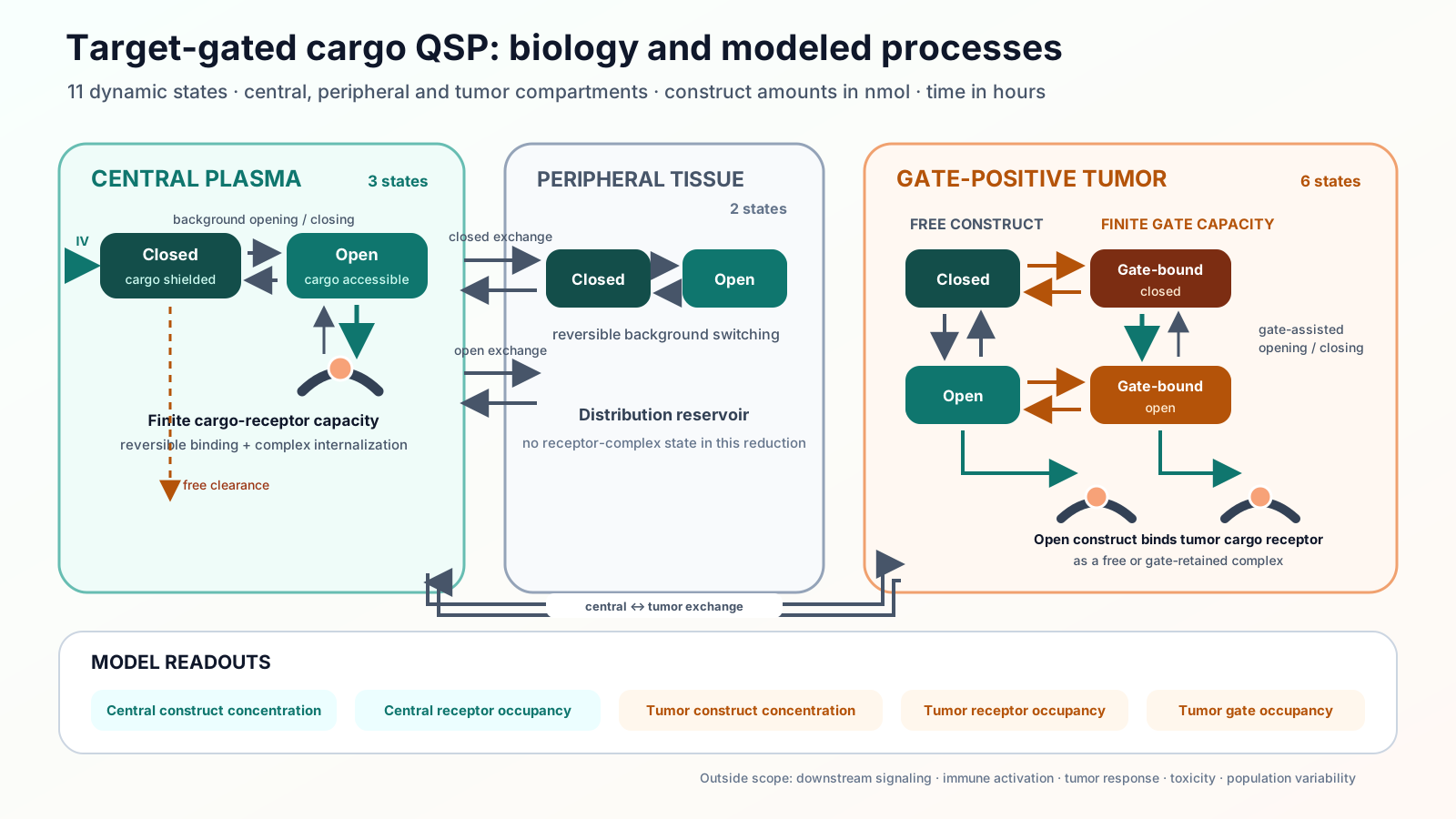
An 11-state, three-compartment model follows closed and open construct in central plasma, peripheral tissue, and tumor. Central open construct can bind a finite cargo-receptor capacity. In tumor, free closed or open construct can bind a finite gate capacity; gate-bound construct switches between closed and open states, and open free or gate-retained construct can engage tumor cargo receptor. The main outputs are central and tumor construct concentrations, receptor occupancy, and tumor gate occupancy.
Model details
21 parameters · 11 states · 11 equations · 19 derived outputs
Classification & API access
- Therapeutic
- generic target-gated cargo
- Modality
- Other biologic or therapeutic modality
- Target
- configurable tumor gate target, configurable cargo receptor
- Disease / scope
- Solid tumors with an accessible tumor-enriched gate target
| Parameter | Default | Unit | Description |
|---|---|---|---|
Accessible tumor gate target capacitygate_capacity_tumor_nmol | 0.15 | nmol | Total accessible binding capacity of the generic tumor-enriched gate target. |
Central peripheral exchange clearanceintercompartmental_clearance_peripheral_L_h | 0.012 | L/h | Symmetric concentration-driven exchange clearance between central and peripheral spaces. |
Central tumor exchange clearanceintercompartmental_clearance_tumor_L_h | 0.00002 | L/h | Symmetric concentration-driven exchange clearance between central plasma and accessible tumor space. |
Background closing ratek_close_background_h | 0.25 | 1/h | First-order closing rate when construct is not bound to tumor gate target. |
Gate bound closing ratek_close_gate_bound_h | 0.03 | 1/h | Effective closing rate while construct remains gate-bound. |
Cargo receptor complex internalizationk_internalize_receptor_complex_h | 0.06 | 1/h | Effective loss rate for receptor-engaged construct; receptor capacity is assumed homeostatically replenished. |
Gate bound construct lossk_loss_gate_bound_h | 0.002 | 1/h | Slow effective loss of gate-bound construct; gate-target capacity is assumed replenished. |
Background opening ratek_open_background_h | 0.004 | 1/h | First-order opening rate when construct is not bound to tumor gate target. |
Gate assisted opening ratek_open_gate_bound_h | 0.3 | 1/h | Effective opening rate after construct binds the tumor gate target. |
Cargo receptor dissociationkoff_cargo_receptor_h | 0.25 | 1/h | Dissociation rate shared by central and tumor cargo-receptor complexes. |
Closed construct gate dissociationkoff_gate_closed_h | 0.25 | 1/h | Dissociation rate of gate-bound closed construct. |
Open construct gate dissociationkoff_gate_open_h | 0.03 | 1/h | Dissociation rate of gate-bound open construct. |
Cargo receptor associationkon_cargo_receptor_per_nM_h | 0.4 | 1/(nM·h) | Association rate shared by free-open and gate-retained open construct. |
Closed construct gate associationkon_gate_closed_per_nM_h | 0.08 | 1/(nM·h) | Association rate between closed construct and free tumor gate target. |
Open construct gate associationkon_gate_open_per_nM_h | 0.12 | 1/(nM·h) | Association rate between open construct and free tumor gate target. |
Central cargo receptor capacityreceptor_capacity_central_nmol | 0.015 | nmol | Homeostatically maintained central capacity available for cargo engagement. |
Tumor cargo receptor capacityreceptor_capacity_tumor_nmol | 0.0015 | nmol | Homeostatically maintained tumor capacity available for cargo engagement. |
Central construct clearancesystemic_clearance_L_h | 0.005 | L/h | Linear clearance applied to free closed and open central construct. |
Central plasma volumevolume_central_L | 3.5 | L | Nominal adult central volume used for exploratory concentration conversion. |
Peripheral accessible volumevolume_peripheral_L | 10.5 | L | Nominal accessible peripheral volume. |
Tumor extracellular accessible volumevolume_tumor_L | 0.004 | L | Nominal accessible tumor extracellular volume. |
Related models
Feedback: helpdesk@unibiointelligence.com.