Anakinra exposure and conditional CRP turnover
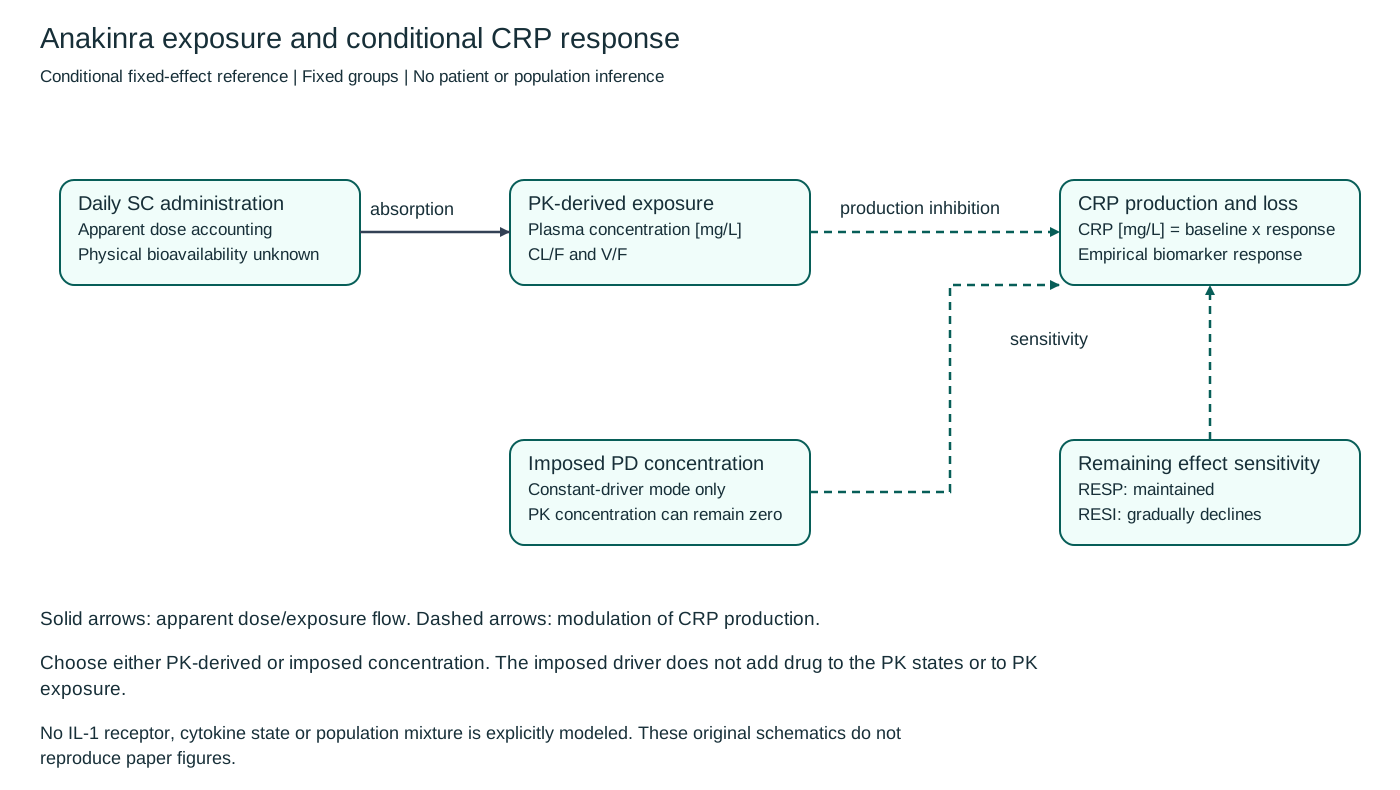
Apparent subcutaneous anakinra exposure inhibits empirical CRP production. Fixed responder and waning-sensitivity groups distinguish sustained suppression from rebound under a constant or PK-derived concentration driver.
Anakinra pharmacokinetics in children and adolescents with systemic-onset juvenile idiopathic arthritis and autoinflammatory syndromes ↗Exploration notes · What are you exploring?
Notes stay on this browser.
MODEL IN MOTION 18 sec
How do response and resistance contexts change the modeled CRP signal?
10 kg, 2 mg/kg/day apparent SC
How does bodyweight-projected apparent SC exposure change under a fixed daily administered dose?
Inputs changed since the displayed result. Run to update the comparison.
Biology
Apparent subcutaneous anakinra exposure inhibits empirical CRP production. Fixed responder and waning-sensitivity groups distinguish sustained suppression from rebound under a constant or PK-derived concentration driver.
Model details
9 parameters · 6 states · 6 equations · 9 derived outputs
Classification & API access
- Therapeutic
- anakinra
- Modality
- Other biologic or therapeutic modality
- Target
- IL1R1
- Disease / scope
- systemic juvenile idiopathic arthritis, autoinflammatory syndromes
| Parameter | Default | Unit | Description |
|---|---|---|---|
Baselinebaseline | 141 | mg/L | Fixed group baseline CRP, not fitted individual baseline. Envelope covers frozen private cases, not public scan or fitting bounds. |
C50c50 | 0.03 | mg/L | Concentration for half initial inhibition of CRP production. Envelope covers frozen private cases, not public scan or fitting bounds. |
Systemic clearancecl | 6.24 | L/h | Apparent clearance CL/F, projected from source bodyweight; physical bioavailability unknown. Exploratory control; interpretation depends on the selected context. |
Imposed PD concentrationconstant_c | 0 | mg/L | Externally imposed PD concentration only when mode is one. Exploratory control; interpretation depends on the selected context. |
Absorption rate constantka | 0.38 | 1/h | First-order SC absorption rate. Exploratory control; interpretation depends on the selected context. |
Loss of effect sensitivitykresi | 0 | 1/h | Decay rate of remaining drug-effect sensitivity; zero for RESP and 0.0048/day for RESI. Exploratory control; interpretation depends on the selected context. |
Crp turnover ratektr | 0.00175 | 1/h | Empirical CRP turnover rate, converted from day to hour. Exploratory control; interpretation depends on the selected context. |
Modemode | 0 | — | Fixed diagnostic switch: zero uses PK-derived concentration, one supplies constant_c. Intermediate mixtures are unqualified. Envelope covers frozen private cases, not public scan or fitting bounds. |
Central distribution volumevc | 65.2 | L | Apparent volume V/F, projected from source bodyweight; physical distribution volume unidentified. Envelope covers frozen private cases, not public scan or fitting bounds. |
Related models
Feedback: helpdesk@unibiointelligence.com.